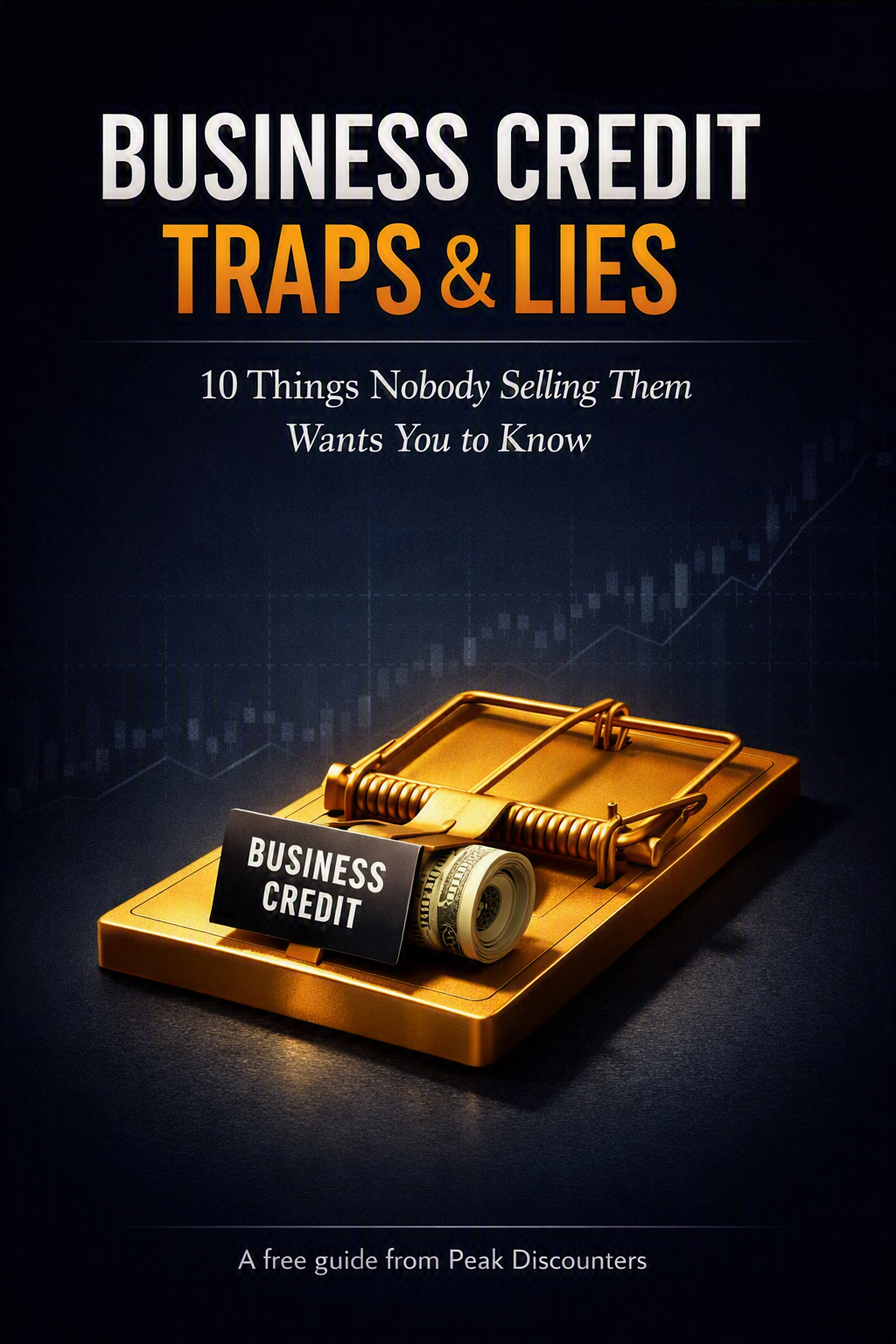
Free Guide · Peak Discounters
Business Credit Traps & Lies
10 things nobody selling them wants you to know — with the real FTC and DOJ cases to prove it.
Read This First
Why we wrote this
Let's be real for a second. You did everything they told you to. You formed the LLC. You got the EIN. You pulled the D-U-N-S number. You opened the net-30 accounts and paid every invoice early. And then you applied for real money—and got declined.
So you went looking for answers. And the internet, being the internet, served you up a buffet of people promising the shortcut. "Get a $50,000 business credit profile in 30 days." "Buy this tradeline." "We guarantee approval." Slick websites. Countdown timers. A guy in a rented Lamborghini telling you the banks don't want you to know this one trick.
Here's the thing nobody in that buffet line is telling you: a lot of it is designed to separate you from your money, and some of it can land you in actual federal prison. Not "you'll get a strongly worded letter" trouble. Twenty-one-years-in-a-cell trouble. We'll show you the case.
In 2024 alone, Americans reported losing $12.5 billion to fraud—a record, and up sharply from the year before (FTC). A big slice of that targets business owners exactly like you, at exactly the moment you're hungry to grow. The scammers know the moment. They wait for it.
We put this guide together because we're in the business credit world, we watch this stuff every day, and frankly we're tired of watching good owners get burned by dressed-up nonsense. Everything in here is built on public records—FTC actions, federal court cases, real numbers. We're not naming and shaming anybody; we're teaching you the patterns, so you can walk into any pitch and spot the trap yourself in about ten seconds.
No fluff. No 47-page PDF that says nothing. Ten traps, real examples of each, the receipts to prove they're real, and—most important—a dead-simple test for each one so you never get caught.
Read it. Keep it. Send it to the friend who's about to swipe their card for a "tradeline package." That's exactly who we made it for.
— The Peak Discounters Team
The Stakes
This isn't a small problem
Synthetic-identity fraud is climbing—fast
Estimated U.S. losses / exposure, in billions of dollars.
The point isn't the exact figure—it's the trend line. A whole industry is being built on manufactured credit, and the people running it need a steady supply of business owners who don't know the tells. Let's make sure that's not you.
Start Here
Business credit in plain English (30 seconds)
Before the traps, the basics—so every "why it's a problem" below actually lands. No jargon, promise.
Business credit is just a record—kept by business credit bureaus like Experian Business, Dun & Bradstreet, and Equifax Business—of how your company borrows money and pays it back. It's separate from your personal credit and your personal FICO score.
A tradeline is one account on that record. Example: a supplier gives you 30 days to pay ("net-30"), you buy $500 of goods, and you pay the invoice. That account—the limit, the balance, whether you paid on time—is a tradeline.
"Reporting" (or "furnishing") means that supplier sends your account's information to a bureau. This is the whole engine: if nobody furnishes your account, no tradeline forms and nothing gets built. That's it. That's business credit.
So as you read, drop each trap into one of three buckets:
- Just a waste of money — you're overpaying for something that's free or worthless. Annoying, but legal.
- It makes you commit fraud — you end up lying to a lender (a fake ID number, an inflated income, a bought account passed off as real). That's your signature on the lie.
- It's illegal to sell — the operator is breaking the law and gets shut down—and customers sometimes get caught in the blast.
The Playbook
The 10 traps — and how to beat every one
The tradeline you can "buy"
This is the big one, and it's everywhere right now—which is exactly why it's Trap #1. The modern version wears a subscription costume: pay a small monthly fee, and they promise to report a big-dollar "tradeline" to your business file. The whole scheme lives in one piece of math nobody points at.
Where you'll see it (start here)
- The subscription "tradeline." Pay, say, $20–$40 a month and they'll report a "$960" or "$1,920 tradeline." Do the arithmetic: that "amount" is simply your monthly fee × the length of the contract ($20 × 48 months = $960; $40 × 48 = $1,920). No goods changed hands. No credit was extended. The number is your own future payments added up—and the newest versions of this sell no real product at all, just the reporting. That's the tell in its purest form.
- "Seasoned" or "primary" tradelines sold as a shortcut to a thick file.
- "Credit piggybacking"—paying to be added as an authorized user on a stranger's account.
The receipts
In plain English — what a "pay-for-tradeline" is
A normal tradeline is "you bought $500 of supplies and paid the bill." A pay-for-tradeline is "you paid a $20 monthly fee and they typed a number onto your report." Nothing was bought. Nothing was borrowed. The account exists only because money changed hands for the reporting itself. Because the bureaus expect a tradeline to represent a genuine credit relationship, an account manufactured from fees is misrepresented data—so they purge it—and the moment you show that fake account to a lender to look creditworthy, the misrepresentation is now on you.
In plain English — the "but they use a legit product!" defense
Here's the slickest version of this trap. The program runs your payments through a real, legitimate credit-builder product—a well-known one that genuinely reports—then says, "see, that company is 100% legal, so we must be legal too." Sounds airtight. It isn't, for two reasons.
First, legitimacy doesn't transfer. A tool being legal doesn't make every scheme built around it legal. A bank account is legal; running a Ponzi through it is not. The honest part can't launder the dishonest wrapper around it.
Second—and this is the one that gives it away—those real credit-builder products build PERSONAL credit, not business credit. They're small consumer lines (often a few hundred dollars, used to buy the provider's own e-books or courses) that report to the consumer bureaus and nudge your personal FICO. So when a program leans on one to look legit while selling you a big "business tradeline," the two don't even match: the legal piece is building a sliver of your personal file, while the business-credit number you're picturing is the part that's manufactured. They're borrowing a personal-credit product's good name to vouch for a business-credit claim it has nothing to do with. The very thing that makes the real product legal—a genuine account, honestly reported for what it actually is—is exactly what the scheme strips out.
The tell
Run the one test: strip out the reporting—did you buy anything real? No. A tradeline is supposed to reflect actual commerce (you bought something, you paid for it). A line manufactured from fees reflects none, and bureaus and lenders are getting very good at spotting and purging accounts that look synthetic. When it's purged, your "credit" vanishes—and you may still be locked into the contract.
Do this instead
Build tradelines that come from real purchases you'd make anyway—supplies, services, inventory—on accounts that report. Real activity survives a second look. Manufactured activity doesn't.
The "net-30 that reports"… that doesn't
You're told a vendor reports your on-time payments to the business bureaus. You open the account, you pay faithfully for months—and nothing ever shows up on your file. You paid for a benefit you never received.
Where you'll see it
- Vendor lists sold as "secret" that are mostly accounts that never report.
- Sellers who won't name which bureau they report to (because the honest answer is "none," or "one nobody checks").
- "Reports to all bureaus!" with zero way to verify it.
The receipts
The tell
Ask one blunt question: "Which specific bureau do you report to, and how often?" A real reporter answers instantly and specifically (e.g., "Experian Business, monthly"). If it's vague, unstated, or "all of them," assume it reports to none.
Do this instead
Only count accounts you can verify are furnishing. Pull your own report after 30–60 days and confirm the tradeline actually landed. If it didn't, it didn't happen.
"Guaranteed approval" / "Guaranteed funding"
Nobody—nobody—can guarantee that a third-party lender will approve you. The lender makes that call, using criteria the "guarantor" doesn't control. So when someone guarantees the outcome, the guarantee itself is the red flag.
Where you'll see it
- "Guaranteed $50K in funding or your money back."
- "Pre-approved" offers that require a big upfront "processing" or "coaching" fee.
- "Credit card stacking" programs that promise a set dollar amount of funding.
The receipts
The tell
The word "guaranteed" attached to a decision someone else makes. And any program that needs your income "adjusted" to get you approved is committing fraud on the application—with your name on it.
Do this instead
Improve the inputs a lender actually weighs—time in business, real revenue, a genuine reporting profile—and apply where you actually qualify. No shortcut is worth a fraud charge on your signature.
The CPN ("credit privacy number")
This one isn't just a waste of money—it's a federal crime. A "CPN" or "credit profile number" is pitched as a legal nine-digit stand-in for your SSN or EIN to start a "fresh file." In reality these are usually stolen or fabricated Social Security numbers, often children's. Using one to apply for credit is fraud.
Where you'll see it
- "Start over with a clean CPN—100% legal!" (It isn't.)
- "Use a CPN instead of your SSN on applications."
- "Secondary credit number" or "credit profile number" packages.
The receipts
In plain English — why it's illegal
Every loan or credit application asks for a real taxpayer ID—your SSN, or your business EIN. A "CPN" is a different nine-digit number you put there instead, so the application isn't tied to your real history. That's lying to the lender about who you are, which is fraud. And that "fresh" number is very often a real person's stolen Social Security number—frequently a child's—so it's identity theft stacked on top.
The tell
Anyone telling you to put a number other than your real SSN or EIN on a credit application is telling you to commit fraud. There is no "privacy number" workaround. Full stop.
Do this instead
Build under your real EIN. It's slower, it's legal, and it can't be unwound by a prosecutor. Your business credit should be an asset, not evidence.
The aged "shelf corporation"
Buy a company that was registered years ago so you look established overnight. The pitch leans on the idea that lenders love age—so rent some. The problem: presenting a hollow shell as a seasoned operating business, to get money you wouldn't otherwise get, is misrepresentation. And underwriters are wise to it.
Where you'll see it
- "Aged shelf corp—10 years old, ready to fund!"
- Packages bundling a shelf corp with "guaranteed" funding (see Trap #3).
- "Instant credibility" or "skip the wait" corporate-age offers.
The receipts
In plain English
Lenders give better terms to businesses with a real track record. A shelf corp lets you claim a track record you don't have—"we've been around since 2015"—when you actually bought an empty company last week. Telling a lender that, to get money you otherwise wouldn't, is misrepresenting your business on the application. The old date on the paperwork doesn't make the story true.
The tell
If the value proposition is "look older than you are to get money you couldn't get honestly," you're buying a misrepresentation. The age of the paperwork doesn't change the age of your actual business.
Do this instead
Let your business earn its age. Time-in-business built on real activity is the version that holds up when someone verifies it—and someone will.
"$100,000 in business credit in 30 days"
Big round number, tiny timeline, lots of urgency. It's designed to get your card out before the math catches up with you. Business credit is built on payment history—a record of accounts used and paid over time. A record, by definition, takes time to create.
Where you'll see it
- "Build $50K–$100K in 30 days—guaranteed!"
- "Fund your business this week with no revenue and no docs."
- Countdown timers and "only 3 spots left" on a page selling a system.
The receipts
The tell
Any timeline that sounds like a diet ad—"100K in 30 days!"—is selling the timeline, not the credit. You can lay the foundation fast (entity, EIN, D-U-N-S, first reporting accounts). A thick, lender-ready profile is months of real, on-time activity.
Do this instead
Start today, but measure in reporting cycles, not days. Open real reporting accounts now; let on-time payments stack up. Boring beats broke.
Paying for your D-U-N-S number
Your D-U-N-S number—the identifier Dun & Bradstreet uses for your business—is free. Full stop. Anyone charging you to "get" one (as opposed to genuinely expediting it) is selling you something you can claim yourself for zero dollars.
Where you'll see it
- "Get your D-U-N-S number—$149!" for the standard, free registration.
- "Required expedited D-U-N-S" framed as mandatory when it isn't.
- Bundles that hide a free item inside a pricey "setup package."
The receipts
The tell
You're being charged for something the issuer gives away. The same move shows up with EIN registration (also free from the IRS). If a "setup fee" is really a markup on a free government or bureau service, walk.
Do this instead
Get your D-U-N-S free from Dun & Bradstreet and your EIN free from the IRS. Spend the money you saved on inventory that actually moves.
"We'll boost your business score"
You can't pay someone to inflate a legitimately earned score. Fixing genuine errors on your report is real and legal. "Boosting" a truthful score is not a service that exists—what's usually being sold is disputing accurate information into temporary disappearance, which snaps back and can dig you deeper.
Where you'll see it
- "Guaranteed 80+ PAYDEX in weeks."
- "We'll remove negative items" (that are accurate).
- Monthly "credit monitoring + boosting" retainers with vague deliverables.
The receipts
In plain English
Fixing a genuine mistake on your report is allowed—that's your right. But "boosting" usually means filing disputes on information that's actually true, to force the bureau to drop it for a while. That's asking the bureau to erase accurate history by pretending it's wrong—deceiving the bureau—and it snaps back, often leaving you worse off than when you started.
The tell
A guarantee to raise a truthful score, or to "remove" accurate negatives, is a promise to deceive a bureau. Legitimate help fixes real mistakes—it doesn't manufacture a better story.
Do this instead
Dispute genuine errors (that's your right), then raise your score the only way that sticks: pay real accounts on time, keep utilization sane, and let the profile mature.
The information paywall ("mentorship")
A free webinar that turns into a $37 course that turns into a $997 "program" that turns into a $10,000 "mastermind." Each tier exists to sell the next. And the "secret" information gating it all? Usually freely available—the funnel is the product.
Where you'll see it
- "Free training" that spends 80% of the time selling the paid tier.
- Escalating "coaching," "mastermind," and "done-with-you" upsells.
- Affiliates earning big commissions to recruit you into the same program.
The receipts
The tell
If the "education" costs more than a semester of community college and the core information is on the bureaus' own websites for free, you're paying for the funnel, not the knowledge.
Do this instead
Learn the fundamentals from primary sources (the bureaus, the SBA, the IRS) and free guides like this one. Pay for real tools and real products—not for permission to learn what's already public.
The lock-in that holds your credit hostage
The subtle one. You sign up, and buried in the pitch is a long contract—plus a warning that canceling will hurt your credit. Now leaving feels dangerous, so you keep paying. The fear of losing the "tradeline" becomes the leash.
Where you'll see it
- Multi-year "installment" contracts dressed up as a tradeline.
- "Cancel anytime—but it'll tank your profile" retention scripts.
- Auto-renewing memberships where the only real product is the reporting.
The receipts
The tell
The pressure to stay is about their revenue, not your credit. A real trade relationship (you buy things, you pay, you can stop buying) never needs to threaten your file to keep you.
Do this instead
Prefer real accounts with real terms you can walk away from—net-30 on supplies you'd buy anyway, cancel-anytime. Your credit should never be the hostage in someone else's subscription.
One More Tell
The rigged comparison chart
Here's a move slippery enough to earn its own warning. A scheme will drop itself into a side-by-side table against a genuinely reputable program—a real, bank-issued credit builder—line up a row of green checkmarks, and land on a triumphant "…and we're cheaper!" The goal is simple: if we're on the same chart as the legit guys, we must be the same kind of thing. It's borrowed credibility, and it's a genuine disservice to everyone who falls for it.
So let's actually compare—because under the hood, the two could not be more different.
Now set the fee-only "tradeline" scheme next to that, honestly:
| Question | Real bank credit-builder | Fee-only "tradeline" |
|---|---|---|
| Who's behind it? | An FDIC-insured, regulated bank | A subscription seller |
| Is real money funded? | Yes—a real loan into a locked savings account | No—nothing is funded |
| Do you get anything back? | Yes—your savings balance returns to you | No—the fee is simply gone |
| Is the reported account real? | Yes—a genuine installment account | No—a number equal to your fees |
| What does "cheaper" even mean? | Small fees/interest; principal returned | A "cheap" fee that buys only the report |
See the trick? "We're cheaper" is meaningless when the products aren't the same thing. One hands you a real, funded, FDIC-insured account and gives your money back; the other hands you a line item that's really just your own payments added together. Drawing a table between them doesn't make them equals—it just uses the honest program's good name as a shield.
The Bottom Line
Real vs. manufactured—at a glance
| Question | Real credit | Manufactured credit |
|---|---|---|
| Are you buying something real? | Yes—goods/services you'd buy anyway | No—the fee is the product |
| Does it survive a lender's second look? | Yes—it reflects real activity | No—can be flagged/purged |
| Is it legal, clearly? | Yes | Often fraud (CPNs, false apps) |
| Can you walk away freely? | Yes | Lock-ins & "it'll hurt your credit" |
| Who is it built on? | Your real EIN & real history | Fees, shells, or stolen numbers |
Here's the whole guide in one sentence: credit you earn from real business activity is an asset; credit you buy as an appearance is a liability waiting to be discovered. The honest way is slower. It's also the only way that's still standing when a lender—or a regulator—takes a closer look.
Want the boring, bulletproof version?
Peak Discounters is a real supply store. You buy the office supplies your business already needs, pay on time, and we report that real activity to Experian Business. No fake tradelines. No fee dressed up as a purchase. Just credit you actually earned—on supplies you were going to buy anyway.
See how it worksSerious about the full business-credit picture—funding, fundability, disputes done right? That's what Trustvane is built for.
About this guide. This is general business education, not legal, financial, tax, or credit advice, and it is not a substitute for professional guidance on your specific situation. Company names and enforcement actions referenced here are drawn from public records (including U.S. Federal Trade Commission press releases and U.S. Department of Justice announcements) and are included to illustrate patterns of conduct that regulators have acted against; they are not allegations by Peak Discounters against any other company. Statistics are attributed to their sources and reflect figures reported as of 2024–2025. Building business credit depends on factors outside any provider's control, and individual results vary.
© Peak Discounters, a brand of Brand Exchange LLC. You received this guide because you requested it. You can unsubscribe from future emails at any time using the link in any message we send.